


Nonprofit AI Adoption Hits 92%, But Only 7% See Major Impact


Nonprofit artificial intelligence (AI) adoption has become nearly universal, but meaningful transformation remains rare.
A new benchmark study from Virtuous and Fundraising.AI finds that 92% of nonprofits are using AI tools in some capacity, yet just 7% report major improvements in their organizational capability — a gap described as an “efficiency plateau.”
Researchers behind "The 2026 Nonprofit AI Adoption Report" surveyed 346 nonprofits in late 2025 to assess how AI is being used and whether that use is translating into measurable fundraising gains.
“The question isn’t whether nonprofits should use AI,” Gabe Cooper, CEO and founder of Virtuous, said in a statement. “I think that debate is largely settled. The real question is how quickly nonprofit teams are adopting AI and fundamentally re-thinking their workflows. Our data shows most organizations are still in the early innings with AI: one person using ChatGPT to help draft an appeal, while the rest of the team is still buried in manual processes and disconnected systems. That’s not a strategy. It’s a workaround.”
Widespread AI Use, Limited Transformation
Nearly four in five respondents report small to moderate improvements from AI use. Those gains tend to show up in faster drafts, quicker research, and improved content quality — valuable efficiencies for time-strapped teams, but largely incremental.
Only 7% say AI has led to major strategic impact, such as doubling prospect research capacity or reallocating staff time from execution to strategy.
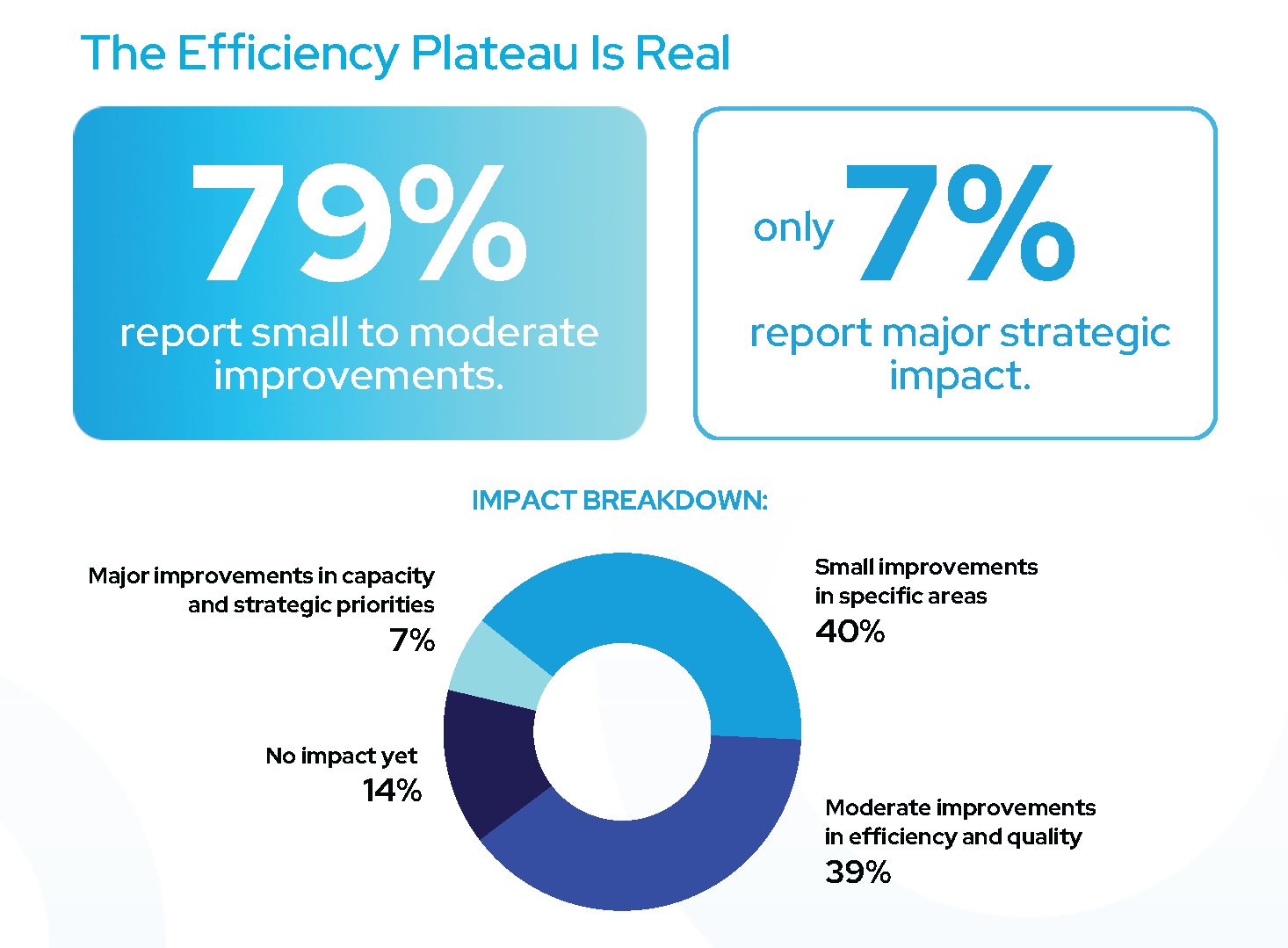
Despite widespread nonprofit AI adoption, only 7% of organizations report major strategic impact, highlighting what the report calls an “efficiency plateau.” | Credit: "The 2026 Nonprofit AI Adoption Report" by Virtuous
How organizations describe their use helps explain the plateau.” Sixty-five percent characterize their AI use as reactive and individual, such as one-off prompts and personal experimentation. Just 18% report operational use across team workflows, and only 7% say AI is embedded into goals, budgets, and performance indicators.
AI Readiness Gaps Limit Impact
If adoption is high but transformation is limited, the difference appears to come down to organizational readiness. The barrier is not access to AI tools but the absence of shared systems around them.
Eighty-one percent of organizations report using AI individually and on an ad hoc basis, while only 4% say they have documented, repeatable workflows. In practice, experimentation often remains personal rather than institutional. The knowledge lives with individual staff members instead of becoming part of how the organization operates.
Governance gaps compound the issue. Nearly half of the respondents report having no formal AI policy. Without clear guidance on what is encouraged, what requires approval, and what is off-limits — particularly when donor data is involved — leaders may struggle to scale experimentation safely across teams.
Measurement is equally limited. The report describes outcome tracking as “very rare,” with most organizations relying on informal observation rather than systematic metrics. Without defined benchmarks, nonprofits cannot easily determine whether AI is expanding fundraising capacity or simply accelerating existing tasks.
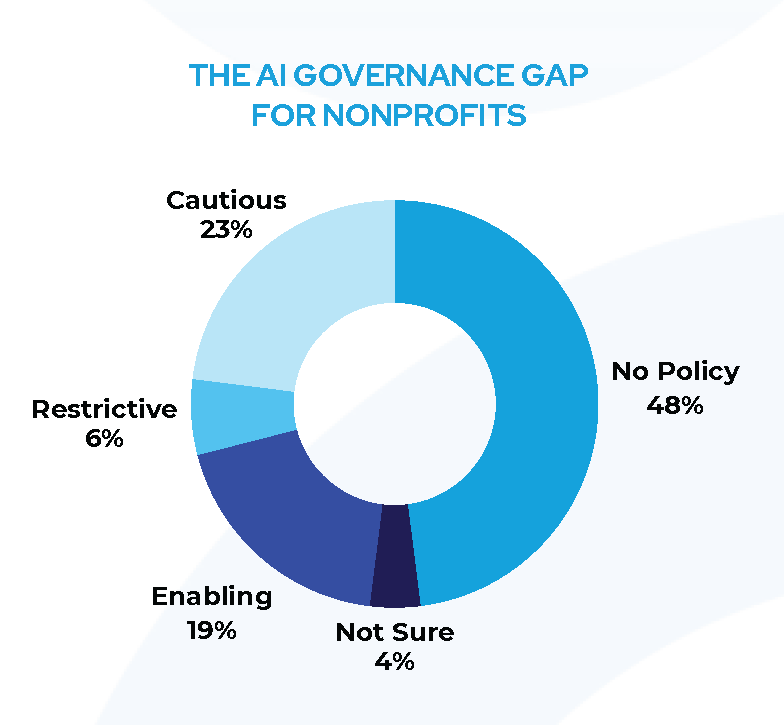
Nearly half of nonprofits report having no formal AI governance policy, signaling structural gaps that may limit the impact of nonprofit AI adoption. | Credit: "The 2026 Nonprofit AI Adoption Report" by Virtuous
Taken together, the findings point to a readiness divide. Roughly one-fifth of organizations have foundational elements in place, including some governance, documentation, and measurement, while about another fifth are at an early experimentation stage and at risk of plateauing without intentional systems. The majority are actively using AI but lack the structure to scale it effectively.
Nathan Chappell, chief AI officer at Virtuous, said the distinction ultimately comes down to integration.
“What we're seeing is that AI only drives meaningful impact when nonprofit organizations rethink how work gets done — not when it's treated as a side experiment individuals run in isolation,” he said in a statement. "The teams pulling ahead are the ones willing to clarify their strategy, establish simple guardrails, and intentionally integrate AI into how decisions are made. When AI becomes part of how the organization thinks — not just what it uses — that's when capacity begins to expand.”
Size Isn’t the Advantage You Might Expect
The data also challenges assumptions about organizational size.
Small organizations, defined as those with fewer than 50 staff, report moderate impact at slightly higher rates than large organizations (41% versus 34%). While larger nonprofits may have more resources, they also face greater coordination and compliance complexity.
Barriers shift as adoption deepens. Among nonprofits not yet using AI, 48% cite lack of training, while 44% say they need guidance on getting started. For those already using AI regularly, concerns shift to privacy and security (32%), as well as time constraints (31%).
In other words, the challenge evolves from “How do we start?” to “How do we scale this responsibly?”
As nonprofit AI adoption continues to climb across the sector, the differentiator is now how intentionally and collectively it is embedded into nonprofit work. Whether nonprofits remain on the efficiency plateau or build systems that expand fundraising capacity, it will define how AI shapes the sector in 2026 and beyond.
- Companies:
- Fundraising.AI
- Virtuous Software
- People:
- Gabe Cooper
- Nathan Chappell
 7 Nonprofit Trends Leaders Should Watch in 2026
 Tatango and Givergy Combine to Form momoGood
 How AI and Privacy Laws Impact Nonprofits
 Apply for IBM's Impact Accelerator Cohort
 Successful AI game planning: Strategies for social good organizations starting their AI journeys
 Euna Solutions Acquires GrantExec
